Riley Betts Proof Fabric
Proof Fabric is the Compliance Operator together with Anchor, as portable trust. Previously called the Trust Fabric. The Compliance Operator is the gate. Anchor is a researched and prototyped pattern: a portable receipt of what was allowed.
The Riley Betts Proof Fabric is the Compliance Operator together with Anchor. The Compliance Operator is the gate. Anchor is a researched and prototyped pattern: a portable receipt of what was allowed. Open source is the evidence. You reach Anchor through the Lean-proved software engagement, not by adopting a second product. The artefact is a trust passport, not a new venue and not the book.
When two internal logs disagree, there is still no artefact that neither firm owns. The Proof Fabric sits in that gap. It does not replace existing rails. It sits beside them. The gate decides locally. Anchor holds the receipt. Validity stays in the off-chain certificate. OTC confirmation is one application, not the definition of the fabric.
When two logs disagree, what artefact neither firm owns?
That is the question. A reconstructed audit trail is not it. A dashboard is not it. A public book of the underlying data is not it.
Portable trust is a compact, independently verifiable receipt: which rule applied, whether it held, at a stated time — including when the answer is no. It can travel between counterparties, examiners, and systems that do not trust each other’s IT. We call that artefact a trust passport.
02 — The ensembleThe gate decides. Anchor holds the receipt.
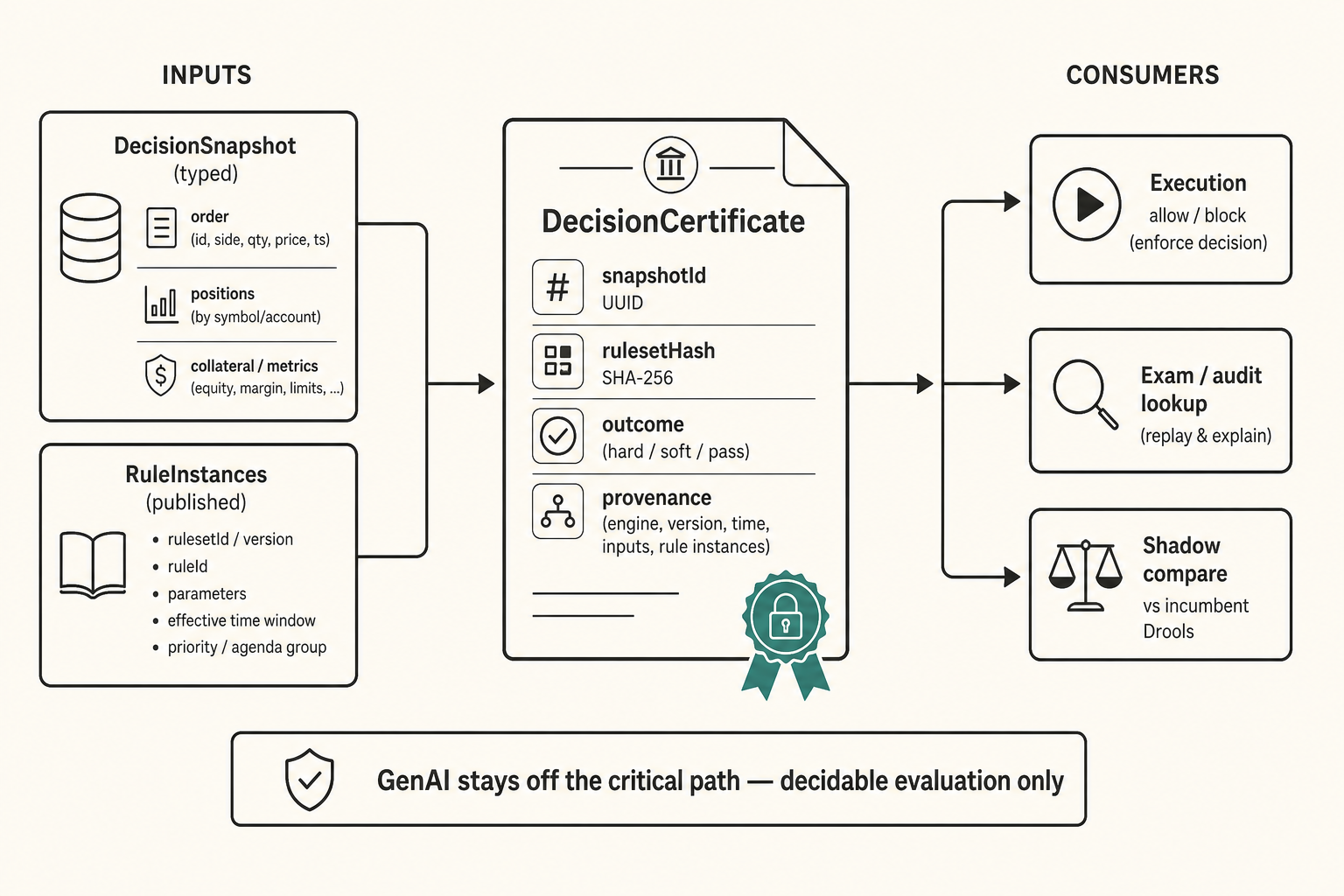
The Compliance Operator is the local gate. It treats the agent as untrusted. The same state and the same action get the same allow or deny. That is the gate.
Anchor is the receipt. Data and application logic stay off-chain, in each owner’s own store. The chain orders, timestamps, and checks a compact proof that a state transition happened. You reach it through the software engagement.
When two parties must agree the same terms and the same compliance hashes, they co-sign once. There is no “my version vs yours.”
Decide locally. Co-sign when the relationship requires it. Anchor the receipt.
03 — What travelsHashes, outcomes, and time. Not the book.
Validity stays in the off-chain certificate. Books, terms, rulesets, and sensitive data stay off-chain. The chain attests existence and time. It does not become the venue, the register, or the matching engine.
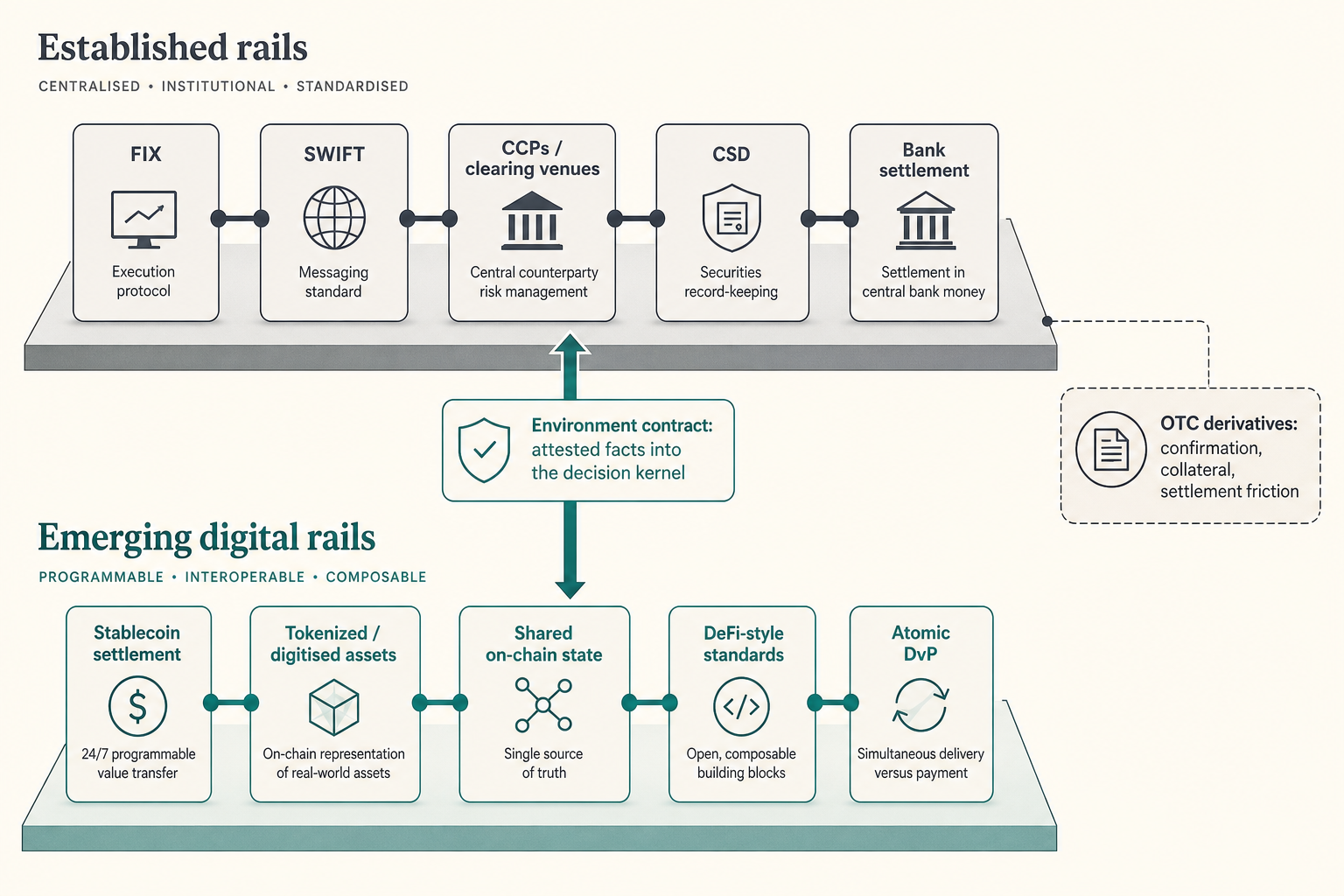
Beside the rails, not instead of them.
- ≠A matching engine or a new legal finality story. The fabric does not become the venue.
- ≠A public book of the underlying data. Confidentiality stays with the owner. The chain carries proofs, not the ledger of the business.
- ≠A replacement for existing rails. Messages, clearing, settlement, and custody endure. The fabric sits beside them.
- ≠“Put it all on chain.” That is the wrong disclosure. Hashes, outcomes, and time travel. The book does not.
The pattern is domain-general.
Wherever a consequential action must be checked locally and a receipt must travel, the same pairing applies. OTC confirmation is one feasibility pilot — see the look-alike case study. That pilot used Ethereum as a stand-in for Anchor. It does not define the fabric.
06 — FAQCommon questions.
What is the Riley Betts Proof Fabric?
The Compliance Operator and Anchor used together. The Compliance Operator is the gate. Anchor is a researched and prototyped pattern. Proof Fabric is not a product.
How do the gate and Anchor differ?
The Compliance Operator is the gate. It decides before an action runs. Anchor is the receipt. Data stays off-chain. Together they are Proof Fabric, and Proof Fabric is not a product.
Is Anchor generally available?
Anchor is a researched and prototyped pattern. You reach it through the Lean-proved software offer. It is not a second product.
Does OTC define the fabric?
No. OTC confirmation is one application of the fabric. The fabric is portable trust, not a trading venue.
Does this replace existing rails?
No. It sits beside them. Messages, clearing, settlement, and custody endure. The fabric carries a portable answer to whether a rule held.
What travels on the chain?
Hashes, outcomes, and time. Validity stays in the off-chain certificate. The book never goes on-chain.
The gate and the receipt, together.
Name the authority for one workflow first. Anchor is part of the software engagement, not a product you switch on.