What the Riley Betts Proof Fabric does that the rest of fintech still can’t
Copilots, messaging upgrades, human-in-the-loop, GRC monitoring and observability, stablecoins, and public-chain books each miss a different part of the same question. The Riley Betts Proof Fabric sits in the gap they leave.
This piece is one application of that fabric — capital-markets OTC confirmation. The architecture itself is CECO plus Anchor: portable trust, not a trading venue.
FIX already carries the order. SWIFT already carries the payment instruction. Neither carries a portable answer to a simpler question:
Did both counterparties screen this OTC trade, under stated rules, at a stated time — and agree the same terms?
That is the question. Most of what the industry currently calls innovation fails to answer it, for different reasons. The interesting product is not a better chat window, a faster confirmation email, or a token that settles. It is a proof fabric: proved policy, a deterministic gate, and cryptographic evidence that can sit above whatever system is acting. That is what we build. We call it the Riley Betts Proof Fabric.
Robert Betts wrote the OTC case at length in For trading, chat was never the product. This piece is the distinction that essay sits on: what our Proof Fabric can do for capital markets and digital-asset trading that the rest of fintech is not yet able to do.
Six innovations. Six things they still cannot do.
| Current innovation | What it actually improves | What it still cannot do |
|---|---|---|
| Chat / LLM copilots | Human attention. Faster tickets, better screens. | A decidable bilateral artefact. The model proposes; it cannot guarantee a rule held. |
| FIX / SWIFT / ISO / workflow RPA | Messages, data quality, and the speed of the email. | A portable, hash-bound answer that neither firm owns. When the logs disagree, you still reconcile. |
| Human-in-the-loop | Human accountability on the action. | Scale at agent speed. Humans are fallible — to mistakes, and to social engineering that is prompt injection aimed at the person, not the model. |
| GRC monitoring and observability | Live telemetry, traces, and dashboards. | Enforce before execution. Observing a breach is not preventing it — and it is not a portable answer neither firm owns. |
| Stablecoins, tokenisation, atomic DvP | Settlement: finality as an observable. | Pre-trade proof, or the death of “my version vs yours.” Atomic delivery does not affirm the trade that preceded it. |
| “Put the OTC book on a public chain” | Shared state — at the cost of the book. | Confidentiality that a desk will actually accept. Firms walk away. The chain becomes the venue they did not want. |
None of these is fake. Copilots help Ops. Messaging standards are how the market speaks. Settlement rails are getting better. Shared ledgers are real. Each one answers a question the market already knew how to ask. None of them answers this one.
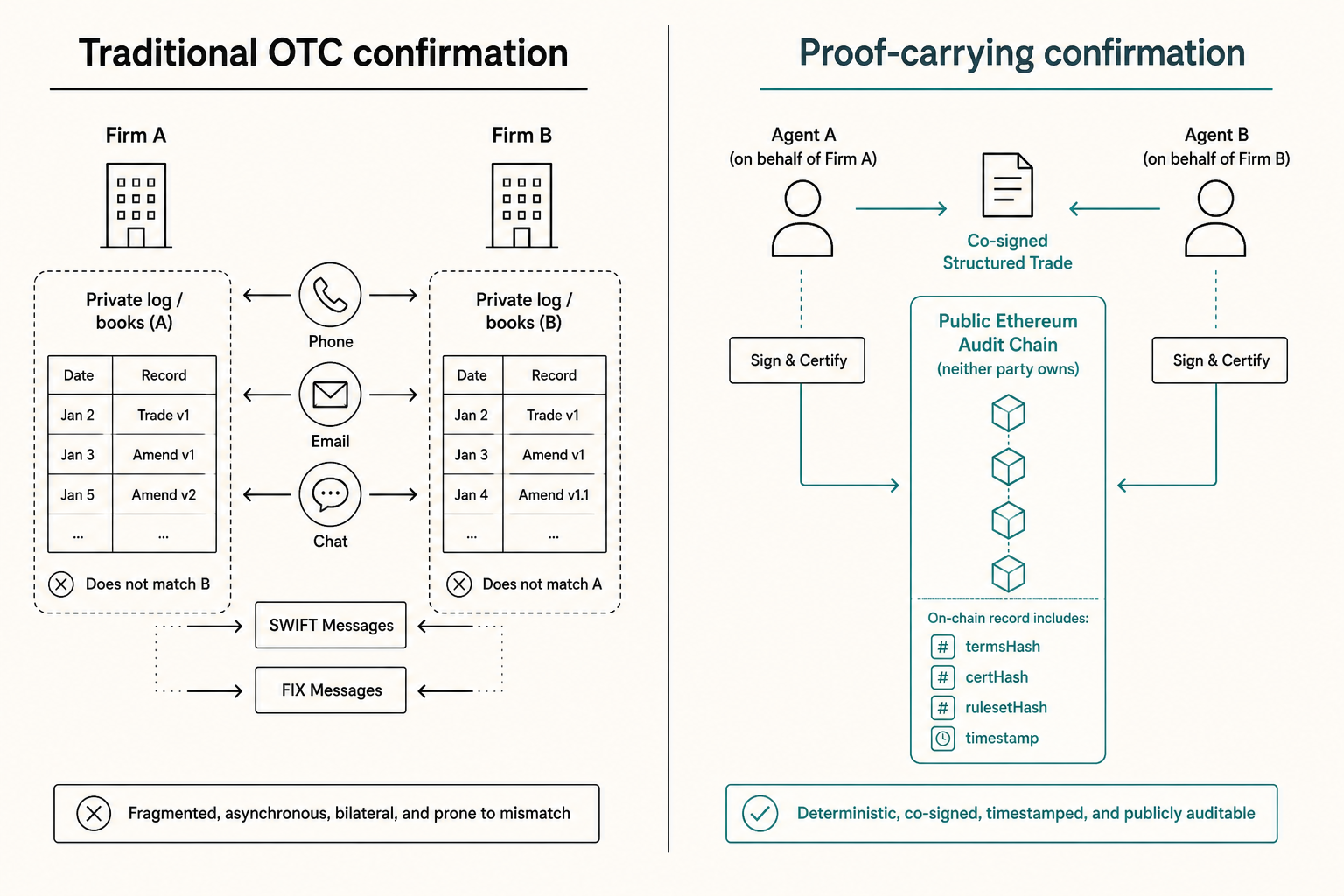
What the Riley Betts Proof Fabric adds
We build formal specification and cryptographic enforcement for regulated AI. The thesis is architectural, not rhetorical. In a regulated environment some rules must always hold. A probabilistic model cannot give you that. So we separate reasoning from authority. The agent proposes. A formally specified validator decides, the same way every time, before anything runs. Every consequential action leaves tamper-evident evidence of which rule applied and whether it held — including when the answer is no.
The enforcement engine in that fabric is CECO, the Cryptographically Enforced Compliance Operator. It treats the agent as untrusted. Prompt injection cannot talk it into a non-compliant transition: the gate is not a prompt. Same state, same action, same allow or deny. Where the data is sensitive, a zero-knowledge proof can show a rule was satisfied without exposing the underlying data — not even to the agent.
That local gate is only one of three moves. For two counterparties, the Proof Fabric has to do something a single firm’s GRC stack never had to:
Prove locally, co-sign once, anchor publicly.
Each firm runs its own gate against its own policy. The two agents co-sign one identical object — terms hash plus both compliance hashes — so there is no “my version vs yours.” A compact receipt is then anchored on a chain neither of them owns: hashes, a booked flag, a timestamp. The chain attests existence and time. Validity stays in the off-chain certificate. The book never goes on-chain. Settlement stays orthogonal: fiat today, stablecoin tomorrow, without rewriting the confirmation.
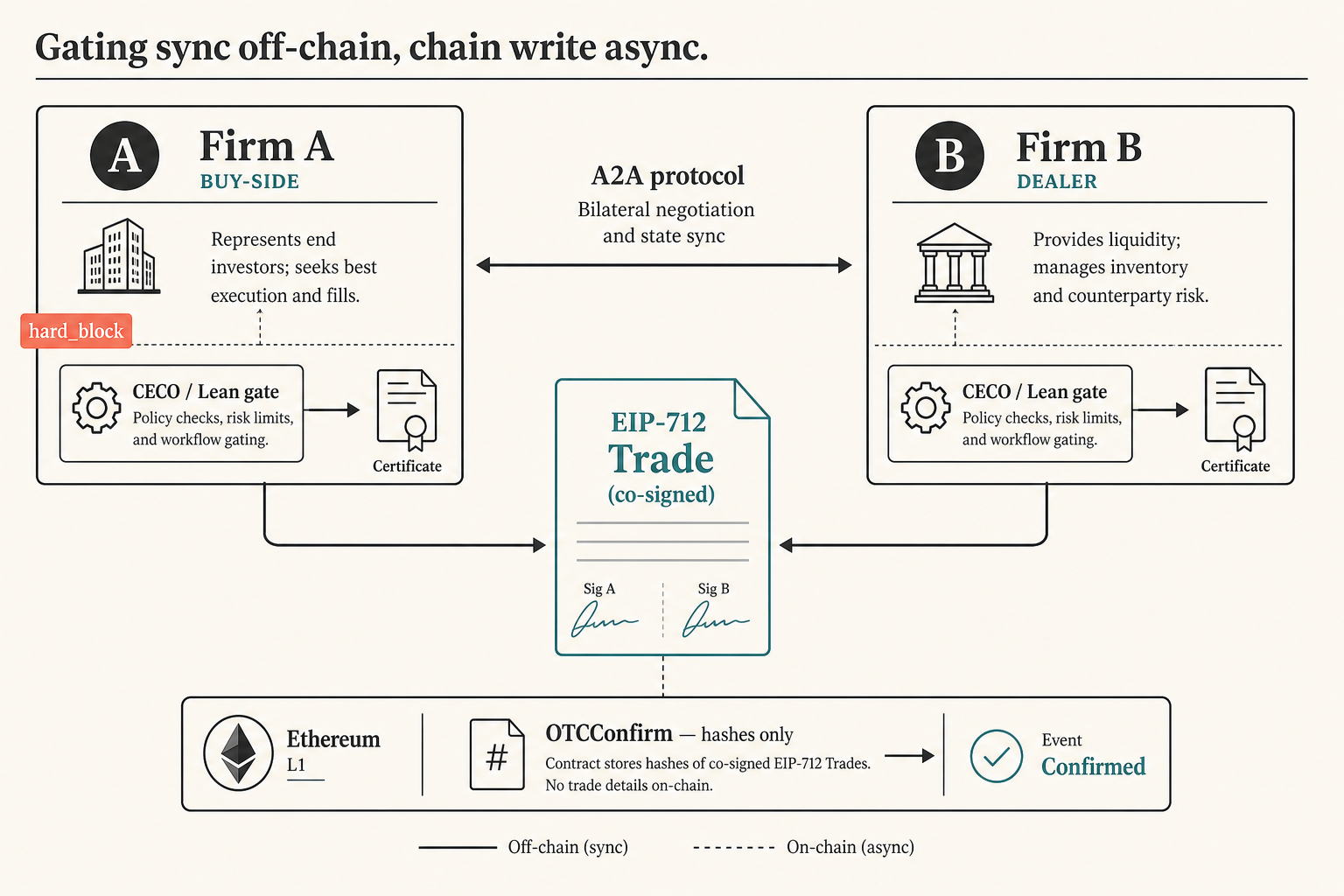
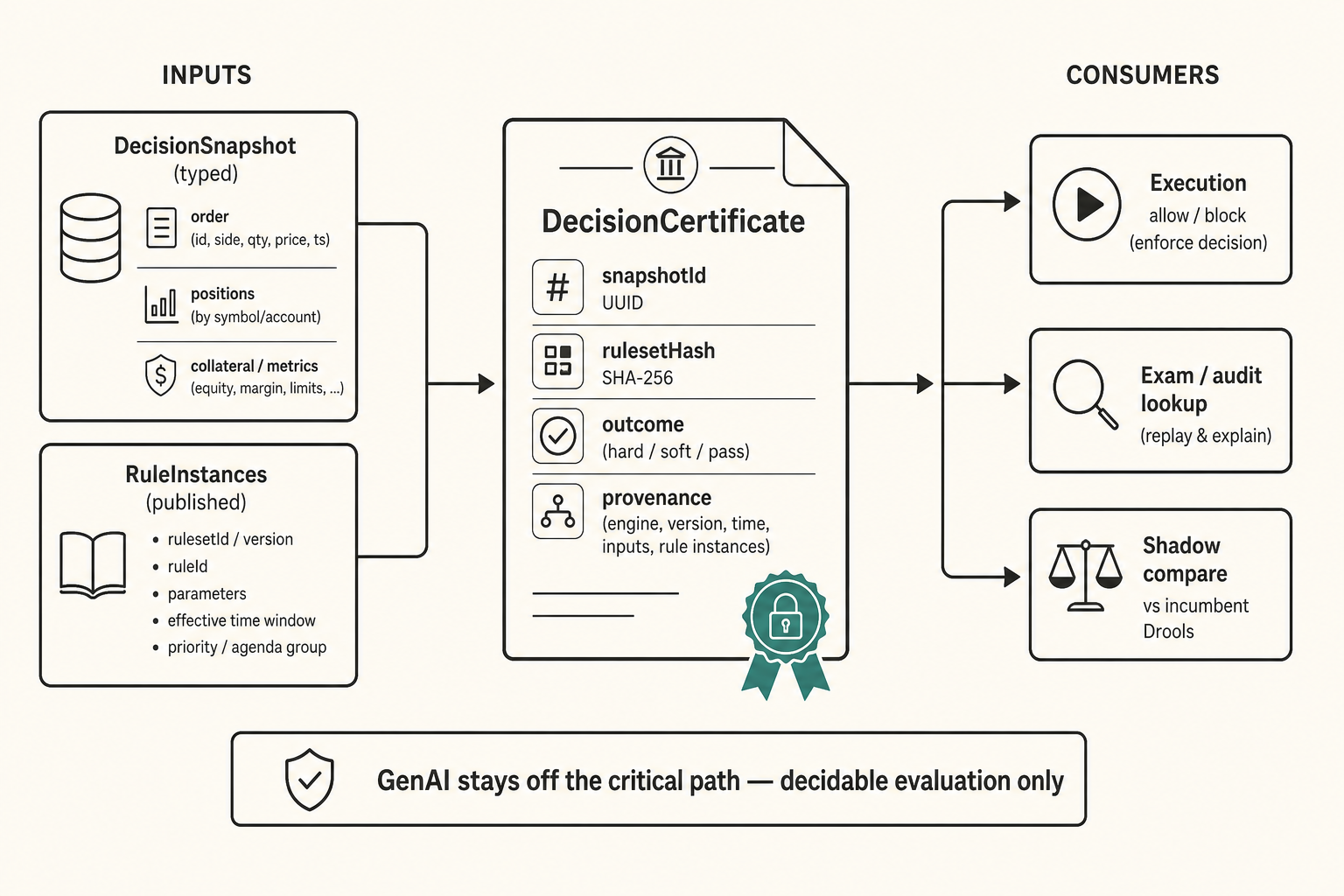
That combination is what the rows above cannot assemble. Copilots do not decide. Messages do not bind both policies to one object. A human in the loop cannot keep pace, and can be socially engineered. Monitoring and observability do not sit upstream of execution. Digital rails do not prove the screen that happened before the settlement instruction. A public book is the wrong disclosure.
The useful demonstration is not a happy-path fill. It is a deny that becomes a first-class shared fact. In the feasibility PoC, a buy-side restriction on an issuer also caught the look-alike future wrapper. The trade did not execute. Confirmation still recorded that both sides screened it, and that it was stopped — a tamper-evident record owned by neither firm’s IT department. Most stacks only leave a trail when something books. Examiners care about the ones that did not.
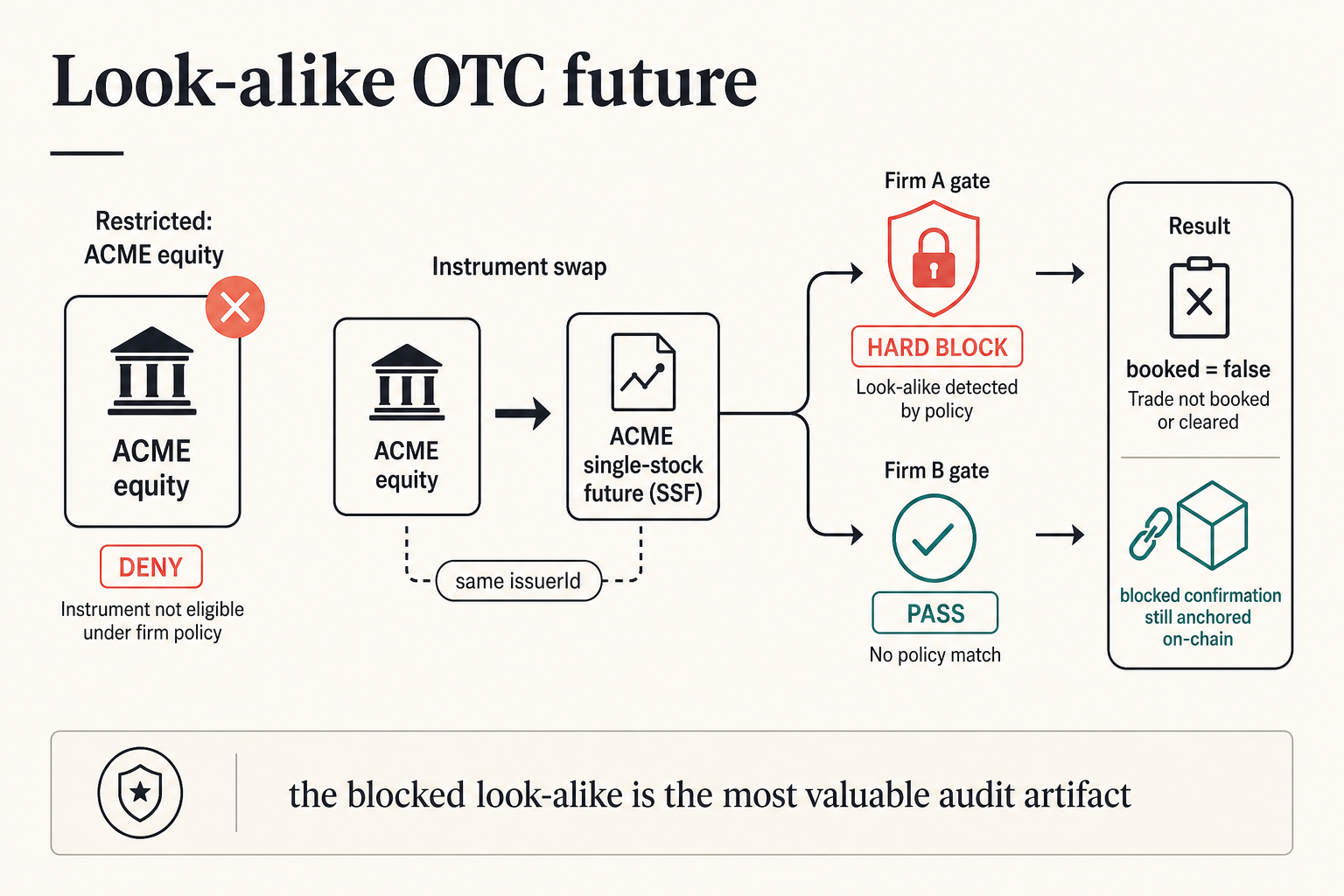
The architecture and the case are on this site: Proof Fabric and the OTC look-alike case study.
Beside the rails, not instead of them
The Riley Betts Proof Fabric does not replace FIX, SWIFT, CCPs, or custody. Those institutions endure for reasons that have nothing to do with chat. It sits beside negotiation and confirmation: a trust passport for a decision, not a new matching venue, not a new legal finality story, not a rip-and-replace of the OMS.
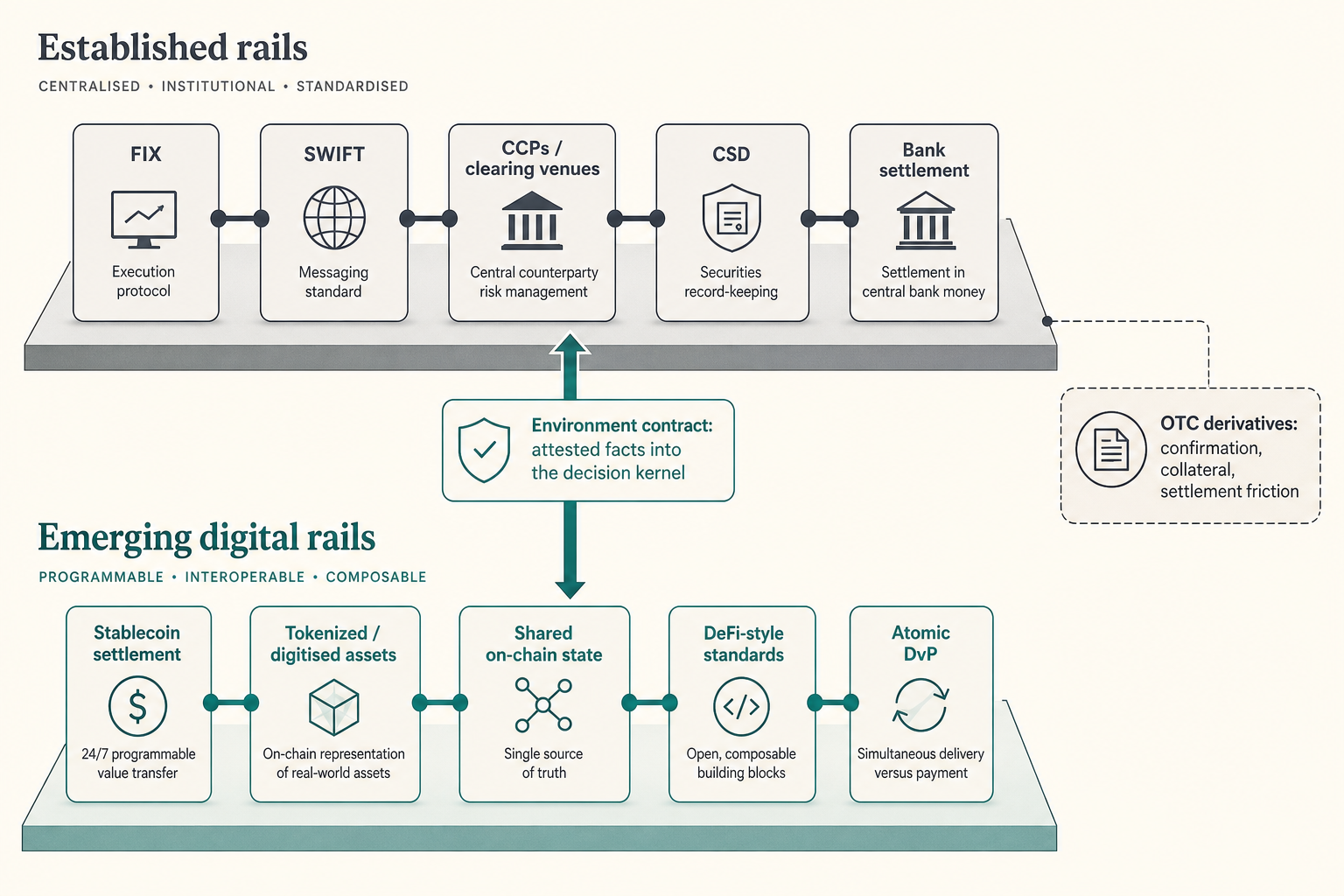
What moves is the artefact the market is currently missing. Intent, attestation, and confirmation can share a machine-checkable spine. Agentic desks raise the cost of incomplete controls. Digital-asset rails make settlement facts crisper, when you want them. Neither, on its own, produces a portable answer to that question.
That is our offer. Proof, not promises — and a public receipt for a trade that may never have booked.
The architecture is CECO plus Anchor — portable trust, of which OTC confirmation is one application. Robert Betts’s OTC case, including the blocked look-alike, is on Substack: For trading, chat was never the product.